Showing posts with label Aboriginal authors. Show all posts

Thursday, 19 April 2018

Corvus / Harold Johnson

3.5 stars out of 5
Eighty years have passed since flash floods, droughts, and tornadoes ravaged the North American landscape and mass migrations to the north led to decade-long wars. In the thriving city of La Ronge, George Taylor and Lenore Hanson are lawyers who rarely interact with members of the lower classes from the impoverished suburb of Regis and the independently thriving Ashram outside the city. They live in a world of personalized Platforms, self-driving cars, and cutting edge Organic Recreational Vehicles (ORVs), where gamers need never leave their virtual realities.

When Lenore befriends political dissenter and fellow war veteran Richard Warner, and George accidentally crash-lands his ORV near the mountain-sheltered haven of a First Nations community, they become exposed to new ways of thinking. As the lives of these near-strangers become intertwined, each is forced to confront the past before their relationships and lives unravel.


The author of this book will be coming to the annual When Words Collide conference here in Calgary in August. I try to read at least one book by each of the guests of honour before the conference and since I am a birder, how could I resist a book called Corvus?

I really enjoyed the book—Mr. Johnson is a talented writer. I loved how many threads he managed to weave into this story, everything from Aboriginal issues to climate change to poverty issues. He also painted an intriguing and rather grim view of the future. I loved his Organic Recreational Vehicles, developed from birds—swans, ravens, hawks, etc. One of the main characters, George Taylor, purchases a Raven ORV and true to Raven’s mischievous nature in Aboriginal tradition, George is taken on some unexpected adventures.

Some of Johnson’s themes are really overt—there are a couple of places where I was dismayed with the bludgeoning of the reader with his opinions (even though I agree with them). That prevented this from being a higher rated read for me—your mileage may vary.

Tuesday, 9 February 2016

The Inconvenient Indian / Thomas King

3 out of 5 stars
The Inconvenient Indian is at once a “history” and the complete subversion of a history—in short, a critical and personal meditation that the remarkable Thomas King has conducted over the past 50 years about what it means to be “Indian” in North America.

Rich with dark and light, pain and magic, this book distills the insights gleaned from that meditation, weaving the curiously circular tale of the relationship between non-Natives and Natives in the centuries since the two first encountered each other. In the process, King refashions old stories about historical events and figures, takes a sideways look at film and pop culture, relates his own complex experiences with activism, and articulates a deep and revolutionary understanding of the cumulative effects of ever-shifting laws and treaties on Native peoples and lands.

This is a book both timeless and timely, burnished with anger but tempered by wit, and ultimately a hard-won offering of hope -- a sometimes inconvenient, but nonetheless indispensable account for all of us, Indian and non-Indian alike, seeking to understand how we might tell a new story for the future.


”[For] me at least, writing a novel is buttering warm toast, while writing a history is herding porcupines with your elbows.”

I might never have read this book, had it not been a selection for my real-life book club. I thoroughly enjoyed the author’s novel The Back of the Turtle last year—it was one of my 5 star selections. His humour and style are both very appealing to me and reading it was like buttering warm toast. But I’m not much of a non-fiction history reader. I feel like I did my time reading history while taking my Canadian Studies degree, and now I want to concentrate on fiction and non-history non-fiction, if you understand me there.

So, I approached this book with trepidation. And what can I possibly say about Thomas King’s The Inconvenient Indian? It is well written—I would expect nothing less from so able an author. He herded his porcupines well.

It is tough. Tough on the dominant society, as it should be. For me, it was tough to read. I imagine as a white Canadian reading this, I felt very much like men feel when they read feminist critiques of modern society. A bit bewildered—okay, I know that things need to change, but how? I didn’t come out of this book with a clear idea of what should be done or if there is anything that I can do to improve the situation.

I would have appreciated a bibliography or a few notes or something—to point me to other reading material should I decide to pursue one of the topics he references.

An important book in the Canadian conversation and one that should be read widely, perhaps taught in our high schools.

Wednesday, 6 May 2015

The Orenda / Joseph Boyden

5 out of 5 stars

In the remote winter landscape a brutal massacre and the kidnapping of a young Iroquois girl violently re-ignites a deep rift between two tribes. The girl’s captor, Bird, is one of the Huron Nation’s great warriors and statesmen. Years have passed since the murder of his family, and yet they are never far from his mind. In the girl, Snow Falls, he recognizes the ghost of his lost daughter, but as he fights for her heart and allegiance, small battles erupt into bigger wars as both tribes face a new, more dangerous threat from afar.

Traveling with the Huron is Christophe, a charismatic missionary who has found his calling among the tribe and devotes himself to learning and understanding their customs and language. An emissary from distant lands, he brings much more than his faith to this new world, with its natural beauty and riches.

As these three souls dance with each other through intricately woven acts of duplicity, their social, political and spiritual worlds collide - and a new nation rises from a world in flux.


It’s hard to even begin writing about The Orenda, which is a powerful history of the Canadian nation. We Caucasian Canadians often forget that our history didn’t begin with the fur traders, the explorers, and the missionaries, that there were long established civilizations in the New World which had their own languages, values, and inter-group relations. Joseph Boyden reminds us of our Eurocentric bias and he is very much the man for the job. He is of Scots, Irish, and Anishinaabe (which you may know as Ojibwa or Algonquin) heritage, educated in a Jesuit school, spending plenty of his childhood in the Georgian Bay area, and still spending time hunting, trapping, and practicing many of the skills which he describes in The Orenda.

Boyden does a masterful job of sharing the praise and the blame equally among the three groups represented in The Orenda, the Jesuits, the Wendat (Huron) and the Haudenosaune (Iroquois). Even Jesuit Père Christophe eventually realizes that the “sauvages” have real, vibrant civilizations, plus great kindness, and he recognizes their basic humanity (which, remember, the Spanish conquistadores did not in South America—they treated the native populations as sub-human). And in the end, Bird, the Wendat leader, recognizes the strength and bravery of the Jesuit priest (who grows into it, to be sure). Boyden can accomplish this because he has a foot in both camps, ancestors on both sides of the divide.

I know that many people have difficulty with the torture depicted in the novel. I look at it as a historical fact—all three of these groups were practicing it, the Wendat and Haudenosaune against each other and the Catholic Church via the Inquisition. And there is still plenty of inhumanity in the world, whether is it through war, annexation of territory, the “rendering” of political prisoners, or beheading videos on the internet.

It would be too easy to set up the Jesuits as the bad guys in a novel like this—and Boyden gives us a much more nuanced view of the situation. The priests do have what they consider to be a higher calling (to convert Indians to Christianity), but they also become aware that they are being used by France to gain territory and hold influence over native populations. None of this would have been possible if the native populations hadn’t wanted the trade goods that were being offered—if they had refused to trade and had only provided resistance, the history of North America could be significantly different. But like all humans, they wanted the new, shiny objects and never imagined that acquiring would involve losing their souls, much like the Third World today is wanting First World technology without realizing that with it comes First World culture. I saw this so clearly when in Bhutan in 2010—the young people were so excited to get connected to the internet, to welcome visitors, to join technological society, but we as outsiders could see that much of what makes their country unique and valuable was very much endangered by exactly those things. And yet, who could deny them their chance to join the 21st century?

I wonder if Boyden will ever re-visit some of the surviving characters in a future novel? I would be very interested in hearing their further adventures if he ever does so. In the meantime, I will certainly be willing to check out his other writing.

Thursday, 16 April 2015

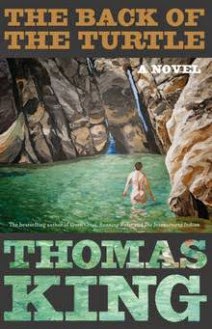
The Back of the Turtle / Thomas King


5 out of 5 stars
In The Back of the Turtle, Gabriel returns to Smoke River, the reserve where his mother grew up and to which she returned with Gabriel’s sister. The reserve is deserted after an environmental disaster killed the population, including Gabriel’s family, and the wildlife. Gabriel, a brilliant scientist working for DowSanto, created GreenSweep, and indirectly led to the crisis. Now he has come to see the damage and to kill himself in the sea. But as he prepares to let the water take him, he sees a young girl in the waves. Plunging in, he saves her, and soon is saving others. Who are these people with their long black hair and almond eyes who have fallen from the sky?

Filled with brilliant characters, trademark wit, wordplay and a thorough knowledge of native myth and story-telling, this novel is a masterpiece by one of our most important writers.  


My first Thomas King novel, but undoubtedly not my last. When I started this novel, I was somewhat reluctant—reading something recommended, rather like taking medicine. Promised good results, but feeling it was a bit of a chore.

That feeling was completely gone within the first chapter. The cast of characters (and they are characters) are charming, even the poor CEO, Dorian, who I came to pity. The scientist, Gabriel, who obliquely caused an event known as The Ruin, comes home to the scene of the crime, intending to see the devastation he caused and to commit suicide. However good he may be at creating toxic substances (the ironically named GreenSweep), he is not very good at self-destruction. He meets a woman who used to live on the Smoke River Reserve that was closed after The Ruin (Mara), the keeper of the hotsprings who speaks in biblical phraseology (Nicholas Crisp), and a young boy who survives by salvaging items from the beach (Sonny).

You cannot help but care for all of these people, who are finding their way in the wake of the disaster, taking care of each other to greater or lesser extents. Their stories are in marked contrast to the CEO of the company which caused the disaster, Dorian who runs Domidion. King takes a lot of pokes at our current system of capitalism through the life of Dorian. One of Dorian’s main scientists has gone missing and can’t be found (that would be Gabriel). Two dams on tailings ponds in the Athabasca area have broken, releasing toxic sludge into the Mackenzie River system and eventually the Arctic Ocean. While investigating this disaster, the media learns of the defection of Gabriel and the connection to GreenSweep and the Smoke River Reserve—Dorian is only saved from disaster by the advent of a bigger news story. But his wife has left him and he is reduced to shopping to try to make himself feel better. We witness his random purchases—expensive ties, extravagant watches, exclusive scent. When he arrives home and is still sad, he attributes the feeling to the fact that he did not buy TWO watches, when really how many watches can one person wear? He truly is the poor little rich man.

Despite its very intelligent swipes at capitalism, environmental problems, consumerism and the like, this is a highly engaging, highly entertaining work which will leave you with a good feeling about the world.