Showing posts with label Historical fantasy. Show all posts

Tuesday, 20 August 2024

A Daughter of Fair Verona / Christina Dadd


4.5 out of 5 stars 

Absolutely fricking delightful! I'm so glad I picked up this mystery, which features Rosaline Montague, daughter of Romeo and Juliet Montague. Yes, you're thinking of the right people. In the first few pages, Rosie regales us with the “real" ending of the story:

Mom grabbed Dad's knife out of the sheath and stabbed herself. There was a lot of blood, and she fainted, but essentially she stabbed that gold pendant necklace her family buried her with, the knife skidded sideways, and she slashed her own chest. She still has the scar, which, when I'm rolling my eyes, she insists on showing me. What with all that blood, she fainted. When she came to, still very much alive, she crawled back up on the tomb, sobbed again over Dad's body, and got wound up for a second self-stabbing. It was at this point Dad sat up, leaned over, and vomited all over the floor. It's a well-known fact you can never trust an unfamiliar apothecary to deliver a reliable dose of poison.

If a semi-modern voice in a historical mystery disturbs you, I would recommend that you give this a chapter or two. I was captured from the first pages (and that dissonance usually drives me nuts), so I encourage open-mindedness. Rosie is an “ancient” unmarried virgin woman (age 20) who has successfully distracted three fiancés with more suitable matches. She likes living at home with her family. Until Romeo reluctantly betroths her to Duke Stephano, who is suspected of poisoning three previous spouses.

Of course, it is the day of the betrothal party that Rosie falls madly in love with Lysander, a young man who has scaled the Montague garden wall to woo her. Her reputation is saved by Prince Escalus, ruler of Verona. She will need his support again when the Duke is discovered stabbed to death in the garden. Can Rosie clear her name, salvage her reputation, and claim her One True Love?

Dodd plays skillfully with the Romeo and Juliet story. What would they be like as older adults? How would they deal with a house full of children? How would their eldest child, Rosaline, react to the uber-romantic saga of her parents' love story? By becoming ultra rational and organized, that's how! Usually, a humorous conceit like this wears thin as the book progresses, but I never tired of Dodd's approach. Her humor was right on the money, especially as Rosie completely overlooks her own attractiveness and misinterprets the actions of the men around her.

So, although Rosie is surprised by the ending, the reader is not. It is charming! I note that this is first in a series and I can hardly wait to see what this Daughter of Montague gets up to next.

Wednesday, 19 February 2020

The Sanctuary Sparrow / Ellis Peters

4 out of 5 stars
In the gentle Shrewsbury spring of 1140, the midnight matins at the Benedictine abbey suddenly reverberate with an unholy sound—a hunt in full cry. Persued by a drunken mob, the quarry is running for its life. When the frantic creature bursts into the nave to claim sanctuary, Brother Cadfael finds himself fighting off armed townsmen to save a terrified young man. Accused of robbery and murder is Liliwin, a wandering minstrel who performed at the wedding of a local goldsmith's son. The cold light of morning, however, will show his supposed victim, the miserly craftsman, still lives, although a strongbox lies empty. Brother Cadfael believes Liliwin is innocent, but finding the truth and the treasure before Liliwin's respite in sanctuary runs out may uncover a deadlier sin than thievery—a desperate love that nothing, not even the threat of hanging, can stop.

It’s been quite a while since I visited Brother Cadfael and perhaps because of that time lapse, I really enjoyed this novel. There truly aren’t too many options for murder in the 12th century, so one story is very like the last. I would classify these books as “cozy mysteries,” and it surprises me how much I like them, not usually being a fan of the cozy. I think it’s the historical nature of the tales that grabs me. It’s like learning history by osmosis while enjoying a good story.

Probably it also helped that I felt like I was getting away with something! I have a stack of previously signed out library books and theoretically this one should have waited until I made some progress on them. Instead, I plunged into this one right away and finished it in only an evening.

Peters does such a wonderful job of populating the abbey with the full spectrum of human frailties! The arrogant, the snob, the teacher, the compassionate, the seeker of justice, everybody is present and we get to observe their interactions. Her grasp of human behaviour is so accurate!

The result may not be tremendously surprising, but the journey is always enjoyable.

Tuesday, 17 December 2019

The Guinevere Deception / Kiersten White

4.25 stars out of 5
There was nothing in the world as magical and terrifying as a girl.

Princess Guinevere has come to Camelot to wed a stranger: the charismatic King Arthur. With magic clawing at the kingdom's borders, the great wizard Merlin conjured a solution--send in Guinevere to be Arthur's wife . . . and his protector from those who want to see the young king's idyllic city fail. The catch? Guinevere's real name--and her true identity--is a secret. She is a changeling, a girl who has given up everything to protect Camelot.

To keep Arthur safe, Guinevere must navigate a court in which the old--including Arthur's own family--demand things continue as they have been, and the new--those drawn by the dream of Camelot--fight for a better way to live. And always, in the green hearts of forests and the black depths of lakes, magic lies in wait to reclaim the land. Arthur's knights believe they are strong enough to face any threat, but Guinevere knows it will take more than swords to keep Camelot free.

Deadly jousts, duplicitous knights, and forbidden romances are nothing compared to the greatest threat of all: the girl with the long black hair, riding on horseback through the dark woods toward Arthur. Because when your whole existence is a lie, how can you trust even yourself?

An excellent re-invention of the King Arthur mythos. Taking a cue from The Mists of Avalon, this version is told from the perspective of Guinevere, a changeling girl sent by Merlin to be King Arthur’s bride.

The big problem is that magic has been banished from Camelot and Guinevere is a manic pixie dream girl! She is looking at the relationship like a job and Arthur is willing to humour her, but as they spend more and more time together, both of them start to think that perhaps they would like to expand that role….now how do they let their desires be known?

White uses some interesting changes in relationships (Mordred isn’t Arthur’s illegitimate son) and some wonderful changes in gender of at least one character to make this a very up-to-date feeling version of the Arthur cycle. By doing so, she freshens up a story that most of us feel that we’re pretty familiar with.

I can hardly wait for the next installment in 2020.

Sunday, 3 November 2019

The Sinister Mystery of the Mesmerizing Girl / Theodora Goss

4 out of 5 stars
Life’s always an adventure for the Athena Club...especially when one of their own has been kidnapped! After their thrilling European escapades rescuing Lucinda van Helsing, Mary Jekyll and her friends return home to discover that their friend and kitchen maid Alice has vanished— and so has their friend and employer Sherlock Holmes!

As they race to find Alice and bring her home safely, they discover that Alice and Sherlock’s kidnapping are only one small part of a plot that threatens Queen Victoria, and the very future of the British Empire. Can Mary, Diana, Beatrice, Catherine, and Justine save their friends—and save the Empire? Find out in the final installment of the fantastic and memorable Extraordinary Adventures of the Athena Club series.

Forget the League of Extraordinary Gentlemen, because now we have The Athena Club. I guess we could call it the League of Monstrous Gentlewomen. Another of the feminist versions of the Victorian time period with plenty of girl power (although the main characters do get justifiably huffy about being called girls when they are full grown women).

Even the female villains outsmart their male counterparts in this particular volume. The women of the Athena Club may sometimes doubt their abilities, but they pull off the caper (with the help of Ayesha of course). Just like most women, they doubt themselves unnecessarily. Plus, they get to rescue Sherlock Holmes!

I know that this series is technically wrapped up with this third book, but it seems to me that there are enough loose threads and unexplored avenues that further adventures could follow, if the author can persuade the publisher to continue. Fingers crossed that there will eventually be another book about the Athena Club!

The Art of Theft / Sherry Thomas

4 out of 5 stars
As "Sherlock Holmes, consulting detective," Charlotte Holmes has solved murders and found missing individuals. But she has never stolen a priceless artwork—or rather, made away with the secrets hidden behind a much-coveted canvas.

But Mrs. Watson is desperate to help her old friend recover those secrets and Charlotte finds herself involved in a fever-paced scheme to infiltrate a glamorous Yuletide ball where the painting is one handshake away from being sold and the secrets a bare breath from exposure.

Her dear friend Lord Ingram, her sister Livia, Livia's admirer Stephen Marbleton—everyone pitches in to help and everyone has a grand time. But nothing about this adventure is what it seems and disaster is biding time on the grounds of a glittering French chateau, waiting only for Charlotte to make a single mistake...

One of the best aspects of my 2019 summer reading list (The Summer of Sherlock) was the discovery of this charming series, the Lady Sherlock series. I’m really enjoying a lot of these feminist revisionist Victorian adventures! The Victorian age as it should have been.

I love Charlotte Holmes as a character and I relate to her when she would rather be at home with a cup of tea and a pastry than out in the world pursuing criminals! I rather favour coffee and popcorn, but it’s the same idea. I have to laugh at her concept of Maximum Tolerable Chins, which is the point at which she restricts her pastry consumption until her clothing fits more comfortably. Been there, done that, my dear Charlotte!

My only disappointment with this book was that it did not deal with the Treadles’ plot line until the very last pages! I really want to know what happens between Inspector and his wife, but it seems that I must wait for the next book.

In the meanwhile, I have to applaud the author for being able to bring Charlotte and Lord Ingram together and then separate them so skillfully, retaining the romantic pursuit and it’s accompanying plot tension into the fourth book of the series. Of course I am also interested in the Livia and Stephen Marbleton situation, but it is Charlotte & Ash who command my attention in terms of relationships.

Ms. Thomas also uses the Maharani’s character deftly as a way to explore colonialism and to introduce a person of colour into the very white, upper-class world that the main characters inhabit.

All in all, I will be very excited when Book 5 is published, hopefully next year.

Wednesday, 23 October 2019

Die on Your Feet / S.G. Wong

3 out of 5 stars
Lola Starke is a PI with a trust fund. Not that she gets everything she wants—or doesn't want. Like being rid of her Ghost, Aubrey O'Connell, for instance. But in Crescent City, Ghosts are commonplace and Hosts are supposed to be happy about it. So Lola's learned to bide her time. It's served her well as a gwai girl raised in a Chinese city.

When two disparate clients won't take 'no' for an answer, Lola reluctantly agrees to both. She and Aubrey are quickly entangled in a murky puzzle of government officials, drug addicts, angry cops, and the gossamer threads of a dangerous plot. Soon enough, the past comes calling with bad news and worse enemies.

This is the '30s and this is Crescent City, where mah-jongg parlours and film studios hold sway. Where the City's highest official is a Ghost with unimpeachable power and a history with Lola's mother. Where secrets last only as long as it takes money to change hands—or a gun to pry them loose.


I read this book to fill the Ghost Stories square of my 2019 Halloween Bingo Card.

I bought this book at the annual writers & readers conference that I attend because I heard the author speak in several sessions that I attended and I was intrigued by her description of her work. Unfortunately, the fit between my tastes and her writing isn’t the best, but it was still a decent read.

Wong has created an interesting world for her characters to inhabit--she doesn’t exactly specify where it is located, but with it’s mash-up of Asian culture, hard-boiled detective, and paranormal elements, we can assume that it is an alternate version of California. She works very hard to make Lola into a female version of Philip Marlowe. The problem is that it’s really difficult to write anywhere near as elegantly as Raymond Chandler, making the comparison of Lola and Marlowe quite unequal.

This seems to be a California that has been dominated by Asian influence, with Christianity and European culture being minority elements. It gives the Caucasian reader of European background a small taste of what it is like to be a minority group, a salutary experience.

Ghosts feature as major characters, but I found them to be much more limited than what I expected. The majority of ghosts are tied to a human host, although the ghostly Mayor of this fictional city has seemingly found a way to stay vital in the world without such tethering. I guess it is realistic that each ghost would have different abilities, just as each person does.

I’m glad that I finally read this book, which I’ve owned for several years now. I like to support local writers and I’m glad that I liked the book.

Wednesday, 2 October 2019

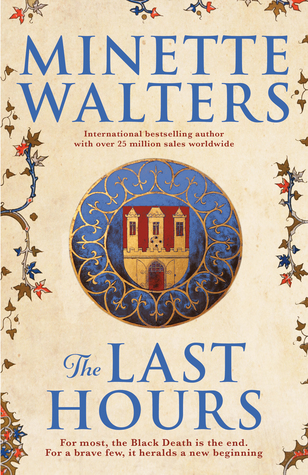
The Last Hours / Minette Walters

4 out of 5 stars
When the Black Death enters England through the port in Dorsetshire in June 1348, no one knows what manner of sickness it is—or how it spreads and kills so quickly. The Church cites God as the cause, and fear grips the people as they come to believe that the plague is a punishment for wickedness.

But Lady Anne of Develish has her own ideas. Educated by nuns, Anne is a rarity among women, being both literate and knowledgeable. With her brutal husband absent from the manor when news of this pestilence reaches her, she looks for more sensible ways to protect her people than daily confessions of sin. She decides to bring her serfs inside the safety of the moat that surrounds her manor house, then refuses entry to anyone else, even her husband.

Lady Anne makes an enemy of her daughter and her husband’s steward by doing so, but her resolve is strengthened by the support of her leading serfs...until food stocks run low. The nerves of all are tested by continued confinement and ignorance of what is happening in the world outside. The people of Develish are alive. But for how long? And what will they discover when the time comes for them to cross the moat again?

As historical fantasy goes, this is very much to my taste. How can I resist a tale about a noblewoman resisting the patriarchy of her time, both socially and religiously? Since I’m a firm believer in the worth of education, the importance of literacy, and in the ability to reason well and plan accordingly, this book was perfect for a cold, snowy day where I prefered to hunker indoors rather than venture out into the snow storm.

This is a departure from Walters’ usual genre, that of the mystery, and I found it to be well done. How difficult it must have been to live through the Black Death, wondering how in the world the disease was spread and being given apocalyptic reasons by the all-dominating Catholic Church. How brave must have been the people who dared to dissent, claiming that God was kinder than the Church was willing to acknowledge? Those who decided that God could not have anything to do with the pandemic.

Some readers may find that the attitudes displayed by Lady Anne and Thaddeus Thurkell to be too modern for the tale. I struggled with that briefly, but got caught up in the story and abandoned my reservations early on. If we are going to enjoy historical fantasy, why not give the characters motivations that modern readers can identify with?

If you enjoy this book, may I also recommend to you Connie Willis’ Doomsday Book and C.C. Humphrey’s Plague.

The Apothecary Rose / Candace Robb

3 to 3.5 stars out of 5
Once the king's captain of archers, now he must penetrate a poisoner's secrets...

Christmastide, 1363-and, at an abbey in York, two pilgrims die mysteriously dead of an herbal remedy. Suspicious, the Archbishop sends for Owen Archer, a Welshman with the charm of the devil, who's lost one eye to the wars in France and must make a new career as an honest spy.

Masquerading as an apprentice to Apothecary Nicholas Wilton, whose shop dispensed the fatal potion, Owen's dark curls, leather eyepatch and gold earring intrigue Wilton's wife. But is this lovely woman a murderess? and what links the Wiltons to bumbling Brother Wulfstan, ascetic Archdeacon Anselm and his weaselly agent Potter Digby, and the ragged midwife Magda the Riverwoman? Answers as slippery as the frozen cobblestones draw Owen into a dangerous drama of old scandals and tragedies, obsession and unholy love...


I read this book to fill the Read by Candlelight square of my 2019 Halloween Bingo Card.

What an excellent way to spend a cold, snowy evening. And yes, we had snow in late September, quite a bit of it and I was happy to hide at home.

I can’t give this novel marks as high as the Brother Cadfael mysteries. I certainly enjoyed it, but would have to rate it from 3 to 3.5 stars. For me, the last chapter just whipped together too quickly, with too little effort on the part of the main characters. I would have found it more to my taste if Owen & Lucie were to remain in limbo until some point in the next book. But I am not a fan of the neatly tied up ending, I much prefer something more ambiguous.

Nevertheless, I have picked up books 2 and 3 of the series at my favourite used book store and I will likely read them before returning them for credit. Although I don’t love Owen Archer as much as I am obviously supposed to, he isn’t the worst mystery character on the market and I’ll give him another chance or two before I abandon the series.


Tuesday, 24 September 2019

The Mask of Ra / Paul Doherty

3 out of 5 stars
His great battles against the sea raiders in the Nile Delta have left Pharoah Tuthmosis II frail, but he finds solace in victory and in the welcome he is sure to receive on his return to Thebes. Across the river from Thebes, however, there are those who do not relish his homecoming, and a group of assassins has taken a witch to pollute the Pharaoh's unfinished tomb. Reunited with his wife, Hatusu, and his people, Tuthmosis stands before the statue of Amun-Ra, the roar of the crowd and the fanfare of trumpets ringing in his ears. But within an hour he is dead and the people of Thebes cannot forget the omen of wounded doves flying overhead. Rumours run rife, speculation sweeps the royal city and Hatusu vows to uncover the truth. With the aid of Amerotke, a respected judge of Thebes, she embarks on a path destined to reveal the great secrets of Egypt.


I read this book to fill the Murder Most Foul square of my 2019 Halloween Bingo Card.

I’ve always been a fan of Ancient Egypt and so I was quite excited to try this ancient historical mystery to see if it would engage me like Pauline Gedge’s fiction does. Her novel Child of the Morning, deals with the same Pharaoh and Queen (Hatshepsut, called Hatusu in this novel).

Perhaps because I had high hopes, I was a bit underwhelmed by this mystery. I loaned this book to a friend for airport reading back in May. She experienced the same feeling and we both found that the writing was good, but overly cluttered with detail. Every table, every piece of clothing, every dish, gets described in loving detail. We get it, Mr. Doherty, you did your research.

The mystery itself was well written. When the murderer was revealed, I was completely surprised. If the next book came easily to hand, I would possibly read it. Unfortunately, my public library does not have the second volume and I am not motivated enough to go scour the used book stores for it, so this will probably end my reading about Amerotke. However, I’m still going to give his Brother Athelstan series a try. Also, I will see if I can shoehorn some Egyptian history into my reading schedule. If I’m to read all the details of life in that period, I’d rather read it as history rather than fiction.

Friday, 20 September 2019

The Witches of New York / Ami McKay

4 out of 5 stars
The year is 1880. Two hundred years after the trials in Salem, Adelaide Thom ('Moth' from The Virgin Cure) has left her life in the sideshow to open a tea shop with another young woman who feels it's finally safe enough to describe herself as a witch: a former medical student and "gardien de sorts" (keeper of spells), Eleanor St. Clair. Together they cater to Manhattan's high society ladies, specializing in cures, palmistry and potions--and in guarding the secrets of their clients.

All is well until one bright September afternoon, when an enchanting young woman named Beatrice Dunn arrives at their door seeking employment. Beatrice soon becomes indispensable as Eleanor's apprentice, but her new life with the witches is marred by strange occurrences. She sees things no one else can see. She hears voices no one else can hear. Objects appear out of thin air, as if gifts from the dead. Has she been touched by magic or is she simply losing her mind?

Eleanor wants to tread lightly and respect the magic manifest in the girl, but Adelaide sees a business opportunity. Working with Dr. Quinn Brody, a talented alienist, she submits Beatrice to a series of tests to see if she truly can talk to spirits. Amidst the witches' tug-of-war over what's best for her, Beatrice disappears, leaving them to wonder whether it was by choice or by force.


I read this book to fill the Spellbound square of my 2019 Halloween Bingo Card.

I first became aware of Ami McKay last Christmas, when I read the novella Half Spent Was the Night: A Witches' Yuletide. That little taste of this world convinced me to choose this book for Halloween Bingo. I am pleased that I was able to include it.

I really love the atmosphere of this book and the novella. The magic is so much an accepted part of this world that you don’t even question whether it exists or not. It does and all the characters believe in it without reservation. The writing is deft and delicate without being fragile, which is good as serious topics are dealt with. One of those is the continuous relationship between witchcraft and organized religion. Another is the nature of friendship and other bonds between people. Also, the nature of life after death.

It makes me want to plant an herb garden, to spend more time outdoors, to write in my journal. It makes me wish that I could go to New York to visit these women and have tea in their shop. I do hope that there may be more books to come, as I would happily re-visit this version of New York again.

Wednesday, 28 August 2019

A Letter of Mary / Laurie R. King

4 out of 5 stars
It is 1923. Mary Russell Holmes and her husband, the retired Sherlock Holmes, are enjoying the summer together on their Sussex estate when they are visited by an old friend, Miss Dorothy Ruskin, an archeologist just returned from Palestine. She leaves in their protection an ancient manuscript which seems to hint at the possibility that Mary Magdalene was an apostle--an artifact certain to stir up a storm of biblical proportions in the Christian establishment. When Ruskin is suddenly killed in a tragic accident, Russell and Holmes find themselves on the trail of a fiendishly clever murderer. Brimming with political intrigue, theological arcana, and brilliant Holmesian deductions.


***2019 The Summer of Sherlock*** 

Whatever I may think of the whole Sherlock Holmes/Mary Russell relationship hook that King has used as the basis for this series, she is a masterful writer of the mystery genre in my opinion. I am perhaps biased, as I thoroughly enjoyed my time as a university student and studied three courses in Ancient Greek as well as a fair bit of Classical history (mostly influenced by H. Rider Haggard’s She: A History of Adventure, I confess) and during that period I was severely tempted by Biblical historicity and documents such as the Dead Sea Scrolls--I can envision myself being just as immersed in theological studies as Mary Russell.

Since reading the first two Theodora Goss novels (The Strange Case of the Alchemist's Daughter and European Travel for the Monstrous Gentlewoman), I am also developing an affection for cross-pollination between fictional works and King provides that in several examples. I was amused when Mary returned from a research day in Oxford, mentioning that she had met a man named Tolkien who was involved in runes, mythology and linguistics.

But the pièce de résistance was an encounter by Mary during an “undercover” adventure with Lord Peter Wimsey! He is never directly identified, but she does call him Pete and his behaviour is unmistakable. She has just been diverted from the buffet by the presence of two women who will unwittingly unmask her and has wandered back to a music room to contemplate her options. There she discovers Wimsey improvising “a three-way hybrid of Schubert’s “March Militaire” performed as a Goldberg Variation by Bach with Scott Joplin occasionally elbowing in,” based on Yes, We Have No Bananas. Mary enjoys watching him, “witnessing one of nature’s rare creatures in its own habitat.”
He screwed his monocle into place with a gesture of buckling on armour, then glided smoothly out into the crowd. I watched with amusement as he greeted his hostess, kissed the fingers of a matched brace of dowagers, shook various hands, greeted the colonel and said something that made him laugh, scooped up three glasses of champagne from a passing tray, and finally, with the ease of a champion sheepdog, cut out his two victims from the flock. Within four minutes from leaving my side, he was strolling down the terrace stones, one fluttering female on each arm, and I stepped out to take a plate. Rule, Britannia, with an aristocracy like that.


King, to my way of thinking, has perfectly nailed the spirit of Dorothy Sayers in this vignette. It made me ridiculously happy. It’s the sheepdog reference that cinched it for me--that is Sayers to the nth degree.

My Summer of Sherlock is drawing to a close, but I am sure that I will continue reading this series for some time to come.
 

Thursday, 8 August 2019

Good Night, Mr. Holmes / Carole Nelson Douglas

3.5 stars out of 5 
Miss Irene Adler, the beautiful American opera singer who once outwitted Sherlock Holmes, is here given an unexpected talent: she is a superb detective, as Oscar Wilde and Bram Stoker can attest. Even Holmes himself must admit--albeit grudgingly--that she acquits herself competently. 

But in matters of the heart she encounters difficulty. The Crown Prince of Bohemia--tall, blonde, and handsome--proves to be a cad. Will dashing barrister Godfrey Norton be able to convince Irene that not all handsome men are cut from the same broadcloth?


***2019 The Summer of Sherlock*** 


I must confess that I went into this mystery not expecting very much and I was pleasantly surprised. I checked out the author’s biography after finishing this novel and found that she has published over 60 books, so I guess that I shouldn’t have been as shocked as I was. This was a decent mystery story, but I have to ask myself why someone who can write this well feels it necessary to include the Irene Adler/Sherlock Holmes aspect to their novel?? Ms. Nelson Douglas must be a true fan of the Holmes stories.

Once again, we have a modern female author taking a female character that Conan Doyle didn’t spend much time on, and giving her her own backstory and fleshing out her motivations. I can definitely see why Irene Adler (“the woman”) would be a tempting target for this treatment.

However, I found my sympathies lying much more with Penelope Huxtaible, Irene’s room-mate and partner in investigation. Nell, as Irene calls her, is an impoverished orphaned parson’s daughter and reminded me strongly of Jane Eyre, with her ideas of propriety and morality. She very much fills a John Watson-like role, recording Irene’s adventures. I know enough Sherlock Holmes lore to realize that Irene would end up married to Godfrey Norton, but I couldn’t help, in this version, wishing that he would choose Penelope instead. Sadly, the author stuck to the canon in this regard.

I loved Irene’s and Nell’s independent ways--supporting themselves quite well and avoiding dependence upon men in the beginning. Godfrey ruins them both by being a wonderful employer to Nell and eventually husband to Irene. In between, Irene has her fling with the Crown Prince of Bohemia and Nell provides the description of the relationship’s ending. Despite knowing how things would turn out, it was a tense, exciting portion of the book.

Opinion seems to be all over the map on this one, but I found that the author managed to insert enough novelty into an old story to make it enjoyable. 

Tuesday, 6 August 2019

The Hollow of Fear / Sherry Thomas

4 stars out of 5
Under the cover of “Sherlock Holmes, consulting detective,” Charlotte Holmes puts her extraordinary powers of deduction to good use. Aided by the capable Mrs. Watson, Charlotte draws those in need to her and makes it her business to know what other people don’t.

Moriarty’s shadow looms large. First, Charlotte’s half brother disappears. Then, Lady Ingram, the estranged wife of Charlotte’s close friend Lord Ingram, turns up dead on his estate. And all signs point to Lord Ingram as the murderer.

With Scotland Yard closing in, Charlotte goes under disguise to seek out the truth. But uncovering the truth could mean getting too close to Lord Ingram—and a number of malevolent forces…


***2019 The Summer of Sherlock*** 

I realize now that I neglected to review the second volume of this series, but suffice it to say that I was excited to get my hands on volume three and that I refused to go to bed until it was finished.

I’m enjoying Ms. Thomas’ interpretation of the Sherlock Holmes story. The autism spectrum in nothing new, despite the fact that it wasn’t named until the 1930s, and undoubtedly it would have been swept under the rug exactly as Bernadine is in this series. Charlotte is depicted as having some of the same tendencies, but she is very verbal and highly observant. But her dislike of being touched and her use of food to calm herself plus her confessed lack of understanding of “normal” emotion seem to indicate her presence on the Spectrum.

What truly captivates me are the overarching plots that run through all of the books. Are Charlotte and Lord Ingram going to become a couple? What will become of the remaining Holmes sister, Livia? Will Charlotte be able to support Bernadine and Livia so that they can escape from their emotionally abusive parents? And what of Inspector Treadles and his wife Alice--can Treadles escape his societal training enough to appreciate her ambition?

I think the Treadles plot line is the most poignant one for me personally. The Inspector has smugly considered his marriage to be perfectly harmonious until the day that his wife reveals that she is disappointed that her father did not leave the running of his manufacturing company in her hands, but rather in the incapable hands of her brother. Rather than ignoring this revelation, it poisons the Inspector’s soul. He also observes that other women that he interacts with do not respond positively to him and he is further dismayed. It is a difficult moment when he begs Charlotte to tell him where he is going wrong and she tells him that although he looks like an open, nonjudgmental person, he reveals himself through his actions to be prejudiced against the aspirations of women and thoroughly disappoints them. It is to his great credit that he listens to her and makes some effort to change. I am quite anxious to see where Ms. Thomas takes him from here. 

It will feel like a long wait until the next book comes out in October. 

Silent on the Moor / Deanna Raybourn

4 out of 5 stars 
In Grimsgrave Hall, enigmatic Nicholas Brisbane has inherited a ruined estate, replete with uncanny tenants and one unwanted houseguest: Lady Julia Grey. Despite his admonitions to stay away, Lady Julia arrives in Yorkshire to find Brisbane as remote and maddeningly attractive as ever. Cloistered together, they share the moldering house with the proud but impoverished remnants of an ancient family: the sort that keeps their bloodline pure and their secrets close. Lady Allenby and her daughters, dependent upon Brisbane and devastated by their fall in society, seem adrift on the moor winds, powerless to change their fortunes. But poison does not discriminate between classes.... A mystery unfolds from the rotten heart of Grimsgrave, one Lady Julia may have to solve alone, as Brisbane appears inextricably tangled in its heinous twists and turns. But blood will out, and before spring touches the craggy northern landscape, Lady Julia will have uncovered a Gypsy witch, a dark rider, and a long-buried legacy of malevolence and evil. Deanna Raybourn spins a gripping tale of loyalty and lust, set against the wild beauty of the Yorkshire moors.

I had to order this book through interlibrary loan, but I am glad that I did. I read all 465 pages in one day--I really didn’t want to set the book down. Raybourn writes a really good Gothic murder mystery/romance. 

Lady Julia Grey is part of that movement that I sense in fiction right now to feminize the story of Victorian times. The role of women was definitely undergoing change during this time period, what with Margaret Sanger’s championing of women’s rights and birth control, plus the Rational Dress and the women’s suffrage movements. Upper class women’s desires to be able to move, to not be subject to restrictive social mores, and to control their own bodies. What must it have been like to have all your choices subject to parents or brothers? 

Julia is a very sympathetic character to the modern female reader. We identify with her desire to pursue what she wants (Brisbane) without having to answer to her stuffy eldest brother. She is fortunate to have a father who is willing to aid and abet. I was also glad to see that Raybourn spreads the restrictions around, writing Julia’s brother Valerius as a frustrated medical doctor. Gentlemen aren’t allowed to “practice trade,” preventing Valerius from becoming what he is meant to be and showing that even men were hemmed in by the social contract of the time.

I’m disappointed that I will once again have to specially request the next volume of this series through interlibrary loan. Plus, I am unsure where Raybourn will be able to take it after the conclusion of this installment, but I am willing to give it a try.

Sherlock Holmes and the Lady in Black / June Thomson

3.5 stars out of 5
By the summer of 1908, Sherlock Holmes has left the Baker Street days of crime and detection behind to take his retirement in a small Sussex cottage overlooking the sea. Holmes extends an invitation to his old colleague and confident, Dr Watson, to join him for a week's holiday. Accepting the summons, Watson arrives anticipating long coastal walks and pub lunches in the local village.

But his holiday takes a darker turn when they spot a shadowy figure below the cliffs one night; Holmes cannot resist the temptation to solve one more mystery and Watson realises he was never invited to the country for recreation. Against the backdrop of the stormy Sussex coast, suspicious men, tragic family history and a crafty theft weave an engaging and complex case that only Holmes and Watson can crack.


***2019 The Summer of Sherlock*** 

In my opinion, Ms. Thomson comes the closest of anyone to capturing the voice of Sir Arthur Conan Doyle. Sometimes I could forget that I wasn’t reading an original Holmes story. The big difference? Doyle could accomplish his mission in a short story. This author required a (short) novel. 

This was a pleasant entry in my Summer of Sherlock. Holmes purists probably won’t be too offended by this offering, but I doubt it will ever be recommended reading. A reasonable mystery story with good twists and turns. I quite enjoyed it, but feel like I am damning it with faint praise!

Wednesday, 31 July 2019

The Strange Case of the Alchemist's Daughter / Theodora Goss

3.75 out of 5 stars
Mary Jekyll, alone and penniless following her parents’ death, is curious about the secrets of her father’s mysterious past. One clue in particular hints that Edward Hyde, her father’s former friend and a murderer, may be nearby, and there is a reward for information leading to his capture…a reward that would solve all of her immediate financial woes.

But her hunt leads her to Hyde’s daughter, Diana, a feral child left to be raised by nuns. With the assistance of Sherlock Holmes and Dr. Watson, Mary continues her search for the elusive Hyde, and soon befriends more women, all of whom have been created through terrifying experimentation: Beatrice Rappaccini, Catherin Moreau, and Justine Frankenstein.

When their investigations lead them to the discovery of a secret society of immoral and power-crazed scientists, the horrors of their past return. Now it is up to the monsters to finally triumph over the monstrous.


***The Summer of Sherlock 2019*** 

I’m giving this book 4 stars simply because it combined so many of the Victorian things that often get written about (plus one I’d never heard of before). Obviously, from my Summer reading list, I’ve read a LOT of fiction involving Sherlock Holmes. He is very attractive to modern writers (and I’ve got some ideas why).

But this book throws in so many things! Firstly The Strange Case of Dr. Jekyll and Mr. Hyde and Other Tales of Terror. Then add The Island of Doctor MoreauFrankenstein, with a little bit of Draculathrown in for good measure. And there is the irresistible lure of Jack the Ripper! Plus I must now track down Nathaniel Hawthorne’s short story Rappaccini's Daughter, to learn more about the poisonous Beatrice.

So much fiction right now is based on Victorian London--it really holds appeal for the modern writer & reader. I wonder if it’s because we live in a time of uneasy change, just like the Victorian era. The industrial revolution was in full swing, just as we are seemingly immersed in the Internet age. The traditional role of women was being challenged just as the Me Too movement has shaken things up in our society. There were more & more people who actually wanted to help those less fortunate rather than maintain their low status, just as we are starting to realize that more & more people are wanting to come to more prosperous countries to start new lives. I think that these similarities draw us to updated Victorian tales. For me, it is especially the feminizing of popular Victorian literature that appeals. Inserting more independent women or women striving for independence.

Perhaps there is also some nostalgia for the times before DNA and forensics, back to when police had to have their wits about them in order to solve crimes. Our tendency to idealize the Good Old Days, which I don’t have to point out weren’t so good for everybody--particularly anyone who was not a wealthy white man. 

Still, I enjoyed this combination of so many literary works and I can certainly see it’s roots in the author’s dissertation. I’ll be interested to read the next book to see where she takes these characters that she has forged into the Athena Club (which is an excellent name, by the way).

Saturday, 20 July 2019

A Study in Scarlet Women / Sherry Thomas

4 out of 5 stars
With her inquisitive mind, Charlotte Holmes has never felt comfortable with the demureness expected of the fairer sex in upper class society. But even she never thought that she would become a social pariah, an outcast fending for herself on the mean streets of London. 

When the city is struck by a trio of unexpected deaths and suspicion falls on her sister and her father, Charlotte is desperate to find the true culprits and clear the family name. She’ll have help from friends new and old—a kind-hearted widow, a police inspector, and a man who has long loved her.

But in the end, it will be up to Charlotte, under the assumed name Sherlock Holmes, to challenge society’s expectations and match wits against an unseen mastermind.


***The Summer of Sherlock 2019*** 
”With your penchant for diminishing a man to little more than a shell of his former manhood, it never ceases to amaze me that you managed to receive all the proposals you did.”
She had indeed reaped her fair share, including one from his brother, Lord Bancroft, her favorite proposal of them all.
“It’s my decolletage--when gentlemen stare at my bosom they don’t hear a word I say. I strongly believe that if trees sprouted breasts tomorrow they would soon be wearing wedding rings.”
He chortled.

What a pleasant surprise! Of all the Holmes pastiche that I have read this summer, this was by far the most original and entertaining. I loved Charlotte Holmes, a young debutante who sees no future to be desired in marriage and has difficulty mastering the small talk and calorie control that is expected of her. She accidentally scares many people with her observations and has a tendency to eviscerate the men who dare to approach. Despite this, she received numerous proposals, all of which she has refused to her parents great unhappiness.

Charlotte makes a deal with her father--if she reaches 18 without finding a man she wishes to marry, he will foot the bill for her education as she attempts to become the administrator of a girls school. When Charlotte reaches that age and tries to obtain her desire, her father reneges. 

This novel consists of the adventures of a young Victorian woman discovering a way to support herself and remain independent of the men in her life. Part of this is the development of her alter-ego, Sherlock Holmes. With the widow Mrs. Watson by her side (John Watson, as it happens, was killed and buried in Afghanistan). 

Books like this one are wish-fulfillment stories for those of us women who choose to remain single and support ourselves. I wish there had been more of this kind of imaginative history available when I was a much younger woman. As it is, I still enjoyed it a great deal and I can hardly wait to get my hands on the next book.

Friday, 12 July 2019

The Daughter of Sherlock Holmes / Leonard Goldberg

3 out of 5 Stars
1910. Joanna Blalock unknowingly is the product of a sole assignation between the late Sherlock Holmes and Irene Adler. After the nurse and her ten-year-old son see a man fall to his death in an apparent suicide, elderly Dr. John Watson and his charming handsome son Dr. John Watson Jr. invite her to join their detective team. From hidden treasure to the Second Afghan War of 1878-1880, the group devise an ingenious plan to catch a murderer in the act while dodging Scotland Yard the British aristocracy. 

***The Summer of Sherlock 2019*** 

I am quite amazed at the sheer number of authors who can’t resist writing about the great detective! In this offering, it is a male author, giving us his version of a daughter of Sherlock Holmes. 

I rather like the enhanced role it gives to Dr. Watson, the surviving member of the duo. He and his dashing son, also a doctor, set about solving a mystery which Joanna Blalock has witnessed. She is soon part of the investigative team and very much on Watson Junior’s mind. 

The story is a bit on the predictable side. There is a cunning criminal, a Lestrade Junior as a foil for the Watson team, a developing romance between Joanna & John Junior, and a plot line very reminiscent of The Sign of the Four.

There are two more books in the series, both of which are available through my public library. However, I am in no rush to get them--there are so many other Holmes pastiche books to be sampled during my summer project and I found this one a bit on the dry side.

A Study in Silks / Emma Jane Holloway

3.5 stars out of 5
London, April 4, 1888 ~ Evelina Cooper, niece of Sherlock Holmes, is ready for her first London Season - except for a murderer, missing automatons, a sorcerer, and a talking mouse. In a Victorian era ruled by a ruthless steam baron council, mechanical power is the real monarch, and sorcery the demon enemy of the empire. Evelina has secretly mastered a coveted weapon - magic that can run machines. Should she trust the handsome, clever rake who speeds her breath, or the dashing trick rider who would dare anything she would ask?

***The Summer of Sherlock 2019*** 


A very steampunk story, with an indirect connection to Sherlock Holmes. The author gives the great detective a sister, who has produced this niece before dying. The niece has been retrieved from her father’s side of the family, a circus family. That’s as in trapezes, not in family hysterics!

So it’s way out there, Holmes-wise. I can’t help but think that the author could have made up a famous detective of her own to fill in for the detective uncle and the story would have been just as good. However, it does tie into a late Holmes story, The Problem of Thor Bridge. This is obviously where Holloway got her inspiration for the Gold King, and the various steambarons who divide London up between them with their monopolistic business ventures.

There are clockwork devices and occasional magic, not at all the usual stuff of Sherlock Holmes stories, but it was a fun little romp and I’m looking forward to the next book. Our heroine, Evelina Cooper, will undoubtedly have to choose between her two men, circus performer Nick and blue blood Tobias. Having burned bridges with both of them in this volume, it will be interesting to see how the author ropes them back in during the next book.

I would warn away the Sherlock Holmes purists from this series, but if you are into Steampunk paranormal romances, A Study in Silks is pretty decent.

Tuesday, 9 July 2019

Warlock Holmes : A Study in Brimstone / G.S. Denning

3 out of 5 stars
Sherlock Holmes is an unparalleled genius who uses the gift of deduction and reason to solve the most vexing of crimes.

Warlock Holmes, however, is an idiot. A good man, perhaps; a font of arcane power, certainly. But he’s brilliantly dim. Frankly, he couldn’t deduce his way out of a paper bag. The only thing he has really got going for him are the might of a thousand demons and his stalwart flatmate. Thankfully, Dr. Watson is always there to aid him through the treacherous shoals of Victorian propriety… and save him from a gruesome death every now and again.


***The Summer of Sherlock 2019*** 

And now for something completely different. Here is a quick quiz to determine if you might enjoy Warlock Holmes:

Do you have some familiarity with Arthur Conan Doyle’s detective?
Are you partial to accordion music?
Do you believe that Mrs. Hudson could benefit from an interested in pornography?:
Do you feel that Dr. John Watson got the short end of the stick in Doyle’s version?
In your opinion, are there too few ogres and vampires in the original?
Are you a fan of Douglas Adams and/or Terry Pratchett?

If you answered “yes” to at least 2 of these questions, I would suggest that you might be amused by this book. Give it a try.